Packaging is your product's handshake. It greets people on shelves and screens long before they ever read a feature list or an ingredients panel.
In a crowded aisle or a scrolling feed, a good redesign can nudge trial and refresh perception. It can signal that you're paying attention to what customers want. On the flip side, a bad one can confuse the folks who already love you.
Before refreshing your packaging, make sure your core brand assets are equally strong. If you're building a new brand or updating an existing one, a logo maker can help you create a professional logo that complements your packaging and reinforces brand recognition.
Don’t worry; this playbook will help you tell the difference between a packaging design refresh and a full-on rebrand. Read on to learn how to carry your customers with you rather than surprise them in the entire process.
Understanding the Difference: Refresh vs. Rebrand
When it comes to packaging, there’s a fine line drawn between refresh and rebrand:
Think of a refresh as a tune-up and a rebrand as rebuilding the engine. Sure, they both have their places in the world of designing. However, they actually solve very different problems.
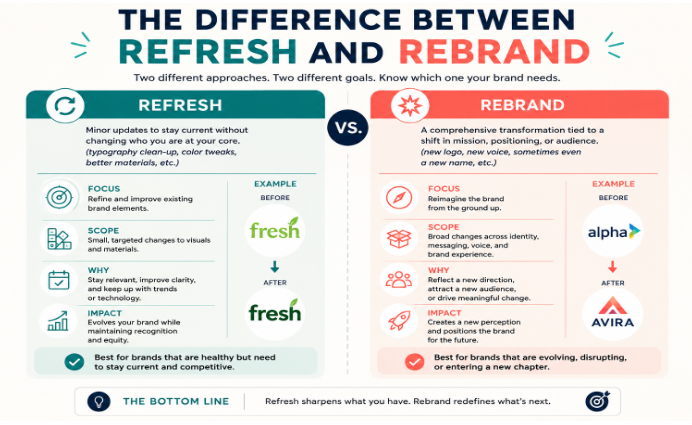
Image source: Generated by the author via ChatGPT
The scope of change should match the underlying business need. Here’s how they differ:
- Refresh – Minor updates to stay current without changing who you are at your core
- Rebrand – A comprehensive transformation tied to a shift in vision, mission, brand positioning, or target audience
Let’s put it simply:
A refresh is about evolution, while a rebrand is about reinvention.
With a refresh, you're polishing what already works and showing that the brand is still current. Meanwhile, a rebrand goes deeper. It reshapes identity and mission (even how the market perceives you).
What to consider? As with choosing between a website refresh and a rebuild, knowing which problem you're solving keeps the project focused.
When To Refresh and Rebrand
Considering a packaging refresh
A refresh makes sense when you're recognizable and relevant. Just a bit behind the curve. Maybe your packaging landed five years ago and hasn't kept pace with your customers' tastes. Or it hasn’t kept pace with your retail's changing realities like e-commerce thumbnails and D2C shipping constraints.
For example: A company selling blank apparel might refresh its product packaging. They’ve done so by simplifying the label design and updating its typography.
The products customers trust stay the same. However, the modern presentation helps the brand stand out online and on retail shelves while appealing to newer buyers.
Signs your brand needs a refresh:
- Your packaging looks dated next to competitors, but your promise hasn't changed
- Category design trends have shifted (more minimal or more sustainable)
- You're seeing audience shifts, like younger shoppers discovering the brand
Benefits of refreshing:
- Keeping hard-won recognition while looking current
- Improving e-commerce readability and in-store blocking
- Boosting perceived quality with better substrates and finishes
Refresh strategies that work:
- Subtle graphic updates and typographic hierarchy that reads at a glance
- Modernized color palette that preserves your distinctive assets
- Material enhancements that feel better and perform better
Opting for a complete rebrand
A rebrand is for big shifts (not small tune-ups). Let’s say you've outgrown your original positioning. You’ve merged with another company. You’ve entered a new category. You’ve discovered your old story no longer fits who you are. That said, you need new branding in the age of AI!
Case in point: Imagine a company known for offering the best land software to independent surveyors.
After evolving into an end-to-end platform for enterprise land acquisition and GIS collaboration, its old identity no longer reflects the scale of its solutions. A complete rebrand helps signal that transformation. This makes it easier to reach larger organizations while reinforcing the company's new direction.
Indicators for rebranding:
- A significant repositioning or a new audience you can't reach with current cues
- Mergers or acquisitions that create brand confusion
- A new vision, mission, values, or product strategy that your old identity can't express
Challenges and gains:
- You risk confusing loyal customers if you cut too many ties too fast
- You open the door to new demographics and more accurate positioning
- You can align your visual and verbal choices with who you are now
Approaches:
- New logo and redefined distinctive assets
- Clear messaging hierarchy and tone of voice overhaul
- Rethought packaging structures and naming systems
How To Maintain Customer Loyalty During Packaging Changes
People form a kind of muscle memory with packages. They reach for color, shape, font, and keywords before they even process brand messages. Change those things, and you can trip them up. Change them without warning, and you risk losing trust.
Heed our advice: Customers feel ownership over the products they love. So, a surprise redesign can feel like a betrayal. Tell them what's changing and why before it hits the shelf. Then, invite them into the process.
However, there’s more to this than you might think. Here’s what you can do:
Communication:
- Use your owned channels to preview what's changing and why
- Add on-pack reassurance like "New look, same product" to reduce anxiety
- Share the story behind material or functional improvements
Inclusion:
- Invite your community to weigh in on early directions and prototypes
- Run A/B tests for key front-panel elements and capture qualitative feedback
- Reward participation with early access or limited editions
Consistency:
- Keep one or two distinctive assets (color block, mascot, pack silhouette)
- Retain familiar product claims and hierarchy where possible
- Stagger rollouts to let shoppers adjust
Case Studies: Lessons Learned and Success Stories
Tropicana: Redesign costing brand recognition
Tropicana's 2009 redesign failure is the poster child for what happens when you abandon hard-earned recognition. By replacing the familiar orange-with-a-straw visual and moving key cues, Tropicana confused shoppers, prompting a swift sales decline before reverting. In hindsight, monitoring tools like call tracking software on customer service lines could have flagged the spike in confused or frustrated calls early, giving the brand a faster signal to act before sales data caught up. The lesson? Protect your distinctive assets unless you're truly starting over.
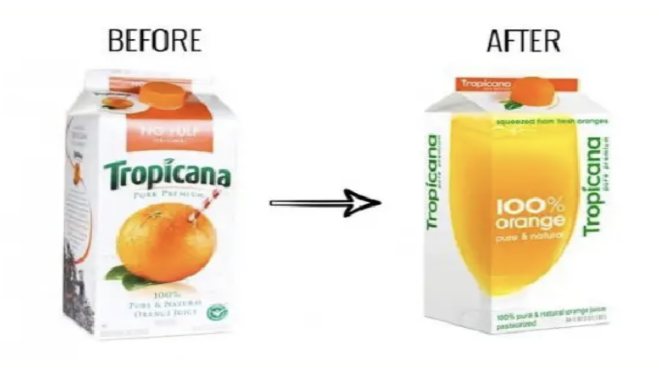
Image source
Sprite: Balancing sustainability with brand recognition
Sprite's move from green to clear plastic bottles in 2022 aimed at better recyclability. The brand communicated the change widely and kept other cues strong, like the green label and signature typography, to keep the package findable on the shelf. Functional change supported by clear storytelling.
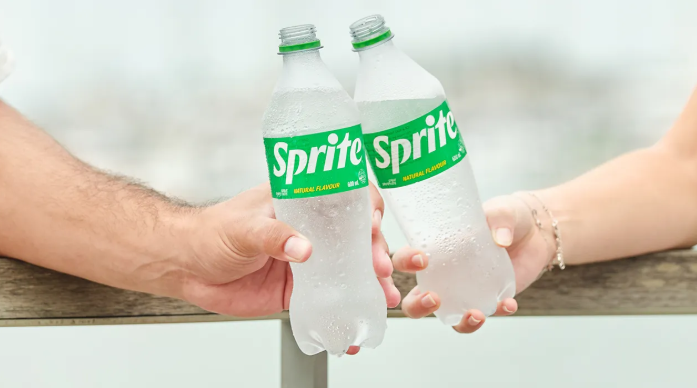
Image source
Pepsi: Modernizing without losing brand equity
Pepsi's 2023 identity refresh shows how a legacy brand can modernize boldness and contrast. Not to mention digital performance without losing its core equities. Even though this was a larger identity move, it respected brand memory by evolving. Not erasing the system!
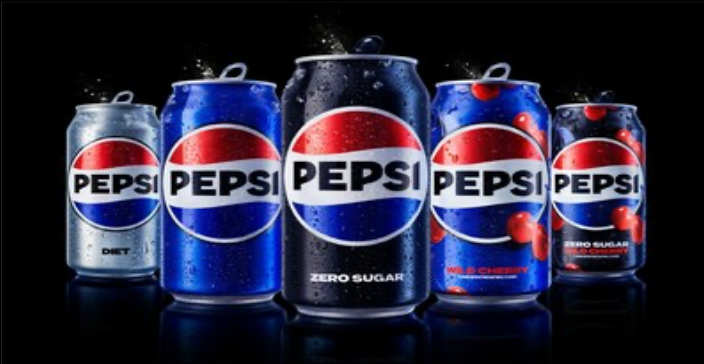
Image source
Each of these examples underscores the same point: keep what people use to find you, explain what's changing, and tie custom designs to real business goals like sustainability, clarity, or new positioning.
Tips for Working with Designers and Branding Consultants
Great outcomes come from great collaboration. You don't need to have all the answers. However, you do need to be clear about the problem you're solving and the constraints you're working within.
The smoothest projects begin with a clear brief and well-defined goals. That way, designers know exactly what success looks like.
That said, keep communication open. Give specific feedback rather than vague feedback. And be honest about your budget and timeline up front. Remember: a strong creative partnership thrives on direction and trust.
Follow the crucial steps below:
1. Set clear objectives
- Define whether you're refreshing or rebranding and why
- List success metrics: recognition, retention, on-shelf standout, e-comm readability, sustainability goals
2. Build open feedback loops
- Share real constraints (die-lines, substrates, print methods, regulatory)
- Give specific feedback tied to goals (not just preferences)
- Test early prototypes with users and retailers to reduce late-stage surprises
3. Plan budget and timeline
- Include time for research, iteration, print proofing, and inventory sell-through
- Budget for photography, copy, dieline changes, and pack testing (not just design fees)
- Map a rollout plan across SKUs, channels, and regions
Final Thoughts
Let’s wrap it up: A refresh helps you stay current without losing the thread. A rebrand helps you tell a new story when you've genuinely changed.
In both cases, the best outcomes come from balancing creativity with evidence…ambition with empathy for the people who already trust you.
That said, match the scope of change to the size of the problem. Also, protect what helps people find you. And lastly, bring customers along for the ride.
Heed our final advice: Keep listening. Keep testing. And keep learning what your audience needs.
Brooke Webber is a passionate advocate for a people-first strategy in HR. Her major focus areas are workplace psychology and employee listening, where she has built strong experience as a writer and industry voice.
Written by DesignCrowd on Friday, July 17, 2026
DesignCrowd is an online marketplace providing logo, website, print and graphic design services by providing access to freelance graphic designers and design studios around the world.
